Kenya Flamingos: Species, Best Lakes, and Shifting Numbers
Kenya flamingos are the lesser and greater flamingos that gather on the Rift Valley’s shallow, alkaline soda lakes, where they filter algae and tiny crustaceans from the water. Yes, there are flamingos in Kenya, and the pink flocks are real, but they do not stay in one place. Lake Nakuru once held more than a million lesser flamingos. A recent census counted about 500 there, while a remote lake in Turkana County held an estimated 737,000.
This guide covers what you need before you go: why the flocks move, which two species you will see, which lakes to visit, and how to plan a safari so the birds are a pleasant surprise instead of a gamble. You will find the figures from Kenya Wildlife Service surveys set side by side, so you can judge the situation yourself.
Laxa Trails Safaris is a Kenya-based tour company founded in 2019 by a guide with more than 14 years in the field. Several of our itineraries pass through Lake Nakuru National Park.
Why Kenya flamingos matter and why they keep moving
Kenya’s flamingos matter because they act as a living gauge of Rift Valley lake health, and that gauge is shifting. Where the birds feed shows which lakes still have the right water, which is why conservationists count them so closely.
What flamingos tell you about the lakes
Lesser flamingos live on spirulina (Arthrospira fusiformis), an alga that grows in salty, alkaline water. The lesser flamingo is the world’s most numerous flamingo, yet it is still classed as Near Threatened. Its future rests on a short list of lakes.
Since around 2010, heavier seasonal rain has raised water levels across the Rift Valley and diluted that chemistry. Lake Nakuru’s surface area is up an estimated 70% against its 1984 to 2009 average, Baringo’s is up 59% and Bogoria’s is up 28%. When the spirulina thins out, the birds leave.
Flamingos follow water chemistry, not the calendar or the park boundary.
The numbers behind the shift
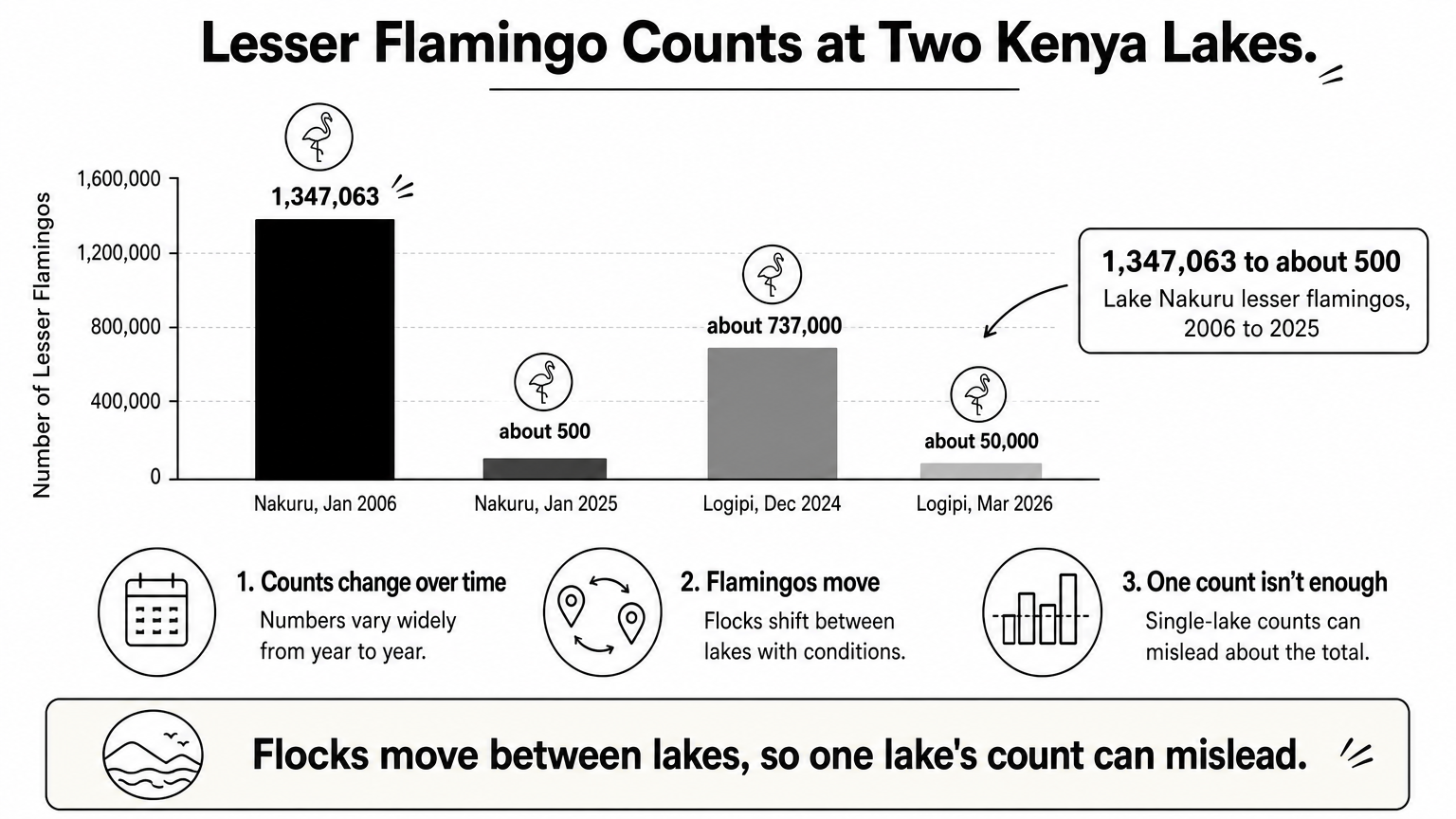
Kenya Wildlife Service surveys give the clearest picture of the movement.
| Lake | Survey date | Lesser flamingos |
|---|---|---|
| Nakuru | January 2006 | 1,347,063 |
| Nakuru | January 2025 | about 500 |
| Logipi | December 2024 (aerial) | about 737,000 |
| Logipi | March 2026 | about 50,000 |
The Logipi drop shows that flocks can move hundreds of kilometers within weeks. Flamingos fly well, and a single-lake count can mislead. That is why Kenya now runs simultaneous counts across seven lakes: Magadi, Bogoria, Nakuru, Naivasha, Elementaita, Baringo and Logipi.
Logipi, in the Suguta Valley, also showed signs of breeding, with juveniles making up 20 to 40 percent of flocks. Unlike Nakuru, Bogoria and Elementaita, it has no formal protection yet.
Types of flamingos in Kenya
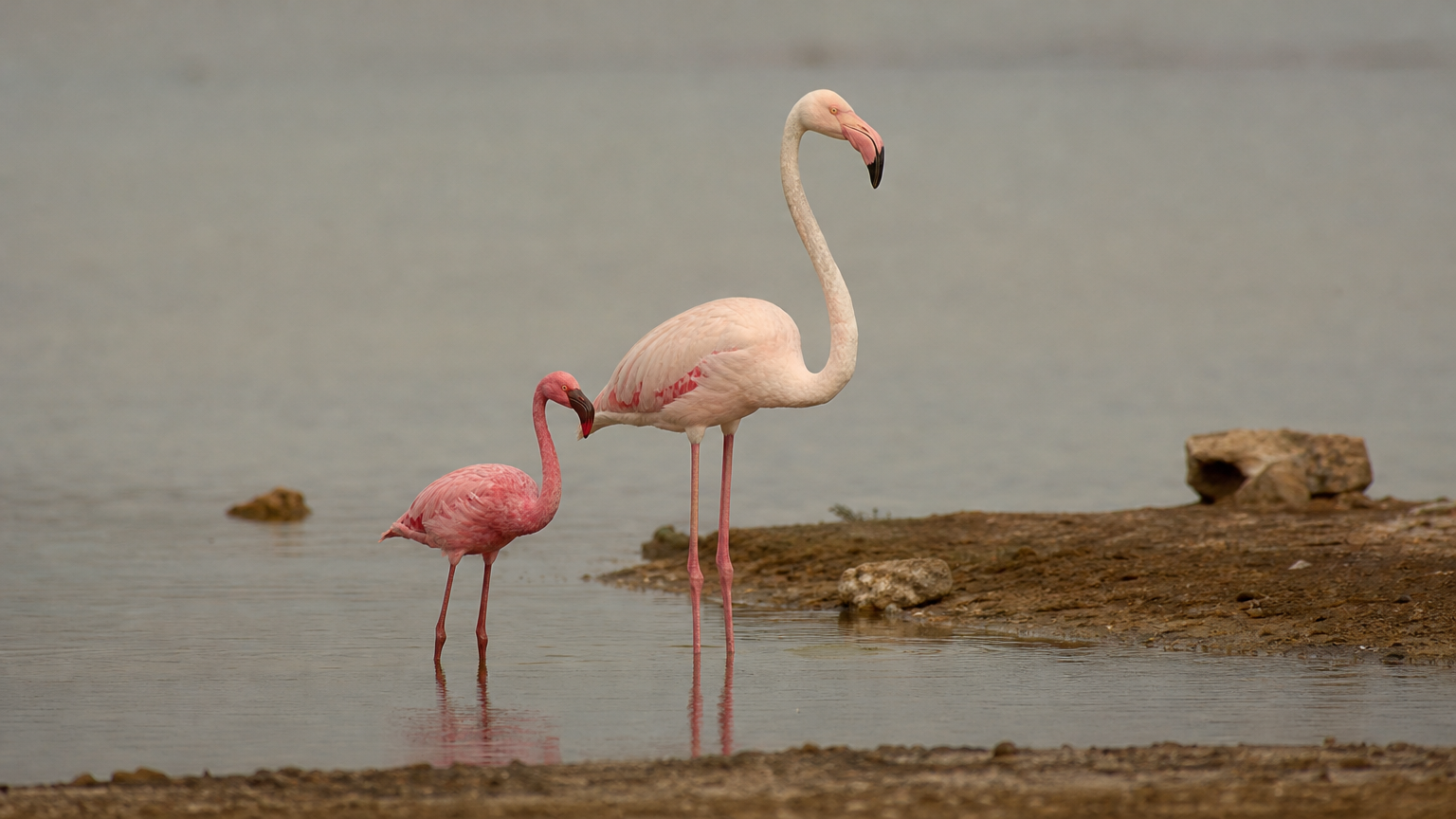
Kenya has two flamingo species, the lesser flamingo and the greater flamingo. Lesser flamingos form the huge pink flocks, and greater flamingos usually stand out as taller, paler birds within them.
How to tell them apart
Size and bill color are the quickest clues when you scan a flock through binoculars.
| Feature | Lesser flamingo | Greater flamingo |
|---|---|---|
| Scientific name | Phoeniconaias minor | Phoenicopterus roseus |
| Size | Smaller | Larger |
| Bill | Deep pink | Pale pink with a black tip |
| Overall color | Deeper pink | Paler pink |
| Feeding | Filters spirulina from alkaline water | Filters small organisms from mud and shallows |
Both species feed by filtering, and their specialized bills strain food from water and mud. Mixed flocks are common, so compare neighboring birds before you decide what you are looking at.
Why flamingos are pink
Flamingos get their color from carotenoids, pigments in the algae and crustaceans they eat. The pigments are stored in feathers, skin and bills. Birds with a poor diet look paler, so a washed-out flock can signal thinner food supplies on that lake.
Chicks hatch without the pink and take several years to develop it. A group of flamingos is called a flamboyance, which suits a flock of bright birds. The name is not a scientific term, but guides use it all the time.
A pale flock usually reflects diet, not a different species.
Where to see flamingos in Kenya
You will find flamingos on the Rift Valley soda lakes, and no single lake is guaranteed any more. Nakuru, Bogoria and Elementaita are the traditional sites, with Logipi and Tanzania’s Lake Natron as the current standouts.
A lake-by-lake guide
| Lake | What to know |
|---|---|
| Nakuru | National park about 160 km north of Nairobi, reachable as a day trip. A Ramsar site. Flamingo numbers have collapsed, but it remains strong for rhinos. |
| Bogoria | Known for hot springs and geysers. Historically a lesser flamingo stronghold, now affected by rising water. |
| Elementaita | Protected lake that has followed a similar decline to Nakuru and Bogoria. |
| Logipi | Remote lake in Turkana County. Estimated 737,000 lesser flamingos in December 2024, with breeding evidence. Hard to reach. |
| Magadi, Naivasha, Baringo | Included in the seven-lake census. Counts change often, so ask for a recent report before you plan around them. |
| Natron (Tanzania) | The long-recognized East African breeding site, close to the Kenya border. Remote, and better for adventure than a standard safari. |
Which lake to choose
For most travelers with three to seven days, Nakuru is the practical choice. It is close to Nairobi, it combines easily with Lake Naivasha and the Masai Mara, and the park is one of the best places in Kenya to see rhinos. Bogoria and Elementaita make sense only if your guide has a recent sighting report.
Logipi is a different kind of trip. It needs serious logistics and local partners, so treat it as an expedition and not an add-on to a classic safari.
Pick the lake for the whole day out, and treat flamingos as the bonus.
How to plan a flamingo sighting on a Kenya safari
To see flamingos in Kenya, build your route around lakes with a recent sighting and keep your expectations flexible. No month can promise a pink shoreline, because the birds respond to water, not seasons.
A five-step approach
- Ask for a current report. Request a sighting from the last few weeks from your operator, not last year’s count.
- Choose lakes that fit your route. Nakuru pairs naturally with Naivasha and the Mara, and you can ask whether Bogoria or Elementaita fits your dates.
- Go early with binoculars. Morning light shows the color, and binoculars let you ID species without approaching.
- Keep your distance. Flocks flush easily, and a spooked flock moves on.
- Value the whole trip. Rhinos, buffalo and the birdlife at Nakuru reward the visit even when flamingos are few.
Laxa packages that include Lake Nakuru
Our 5-Days Big Five Kenya Safari starts at Lake Nakuru National Park and continues to the Masai Mara. It includes game drives, a Lake Naivasha boat ride, a walking safari and a Maasai village visit, listed at $1,460, down from $1,550. Our 5-Days Safari Lake Naivasha, Hell’s Gate, Lake Nakuru and Maasai Mara adds rhino tracking at Nakuru and is listed at $1,765. International flights are excluded on both.
We also build customized itineraries, so you can ask for a lake detour.
The best flamingo plan is a good itinerary with flexible lake choices.
Plan around the water, not the postcard
Kenya’s flamingos are still worth seeking out, but they are moving. Lesser flamingos follow spirulina, and rising water has pushed them away from Nakuru, Bogoria and Elementaita toward lakes like Logipi. Greater flamingos join them in smaller numbers. Knowing the two species, the lakes and the current counts lets you plan with open eyes.
If you want a Kenya safari that includes Lake Nakuru and leaves room for a flamingo detour, talk to Laxa Trails Safaris about a custom itinerary.