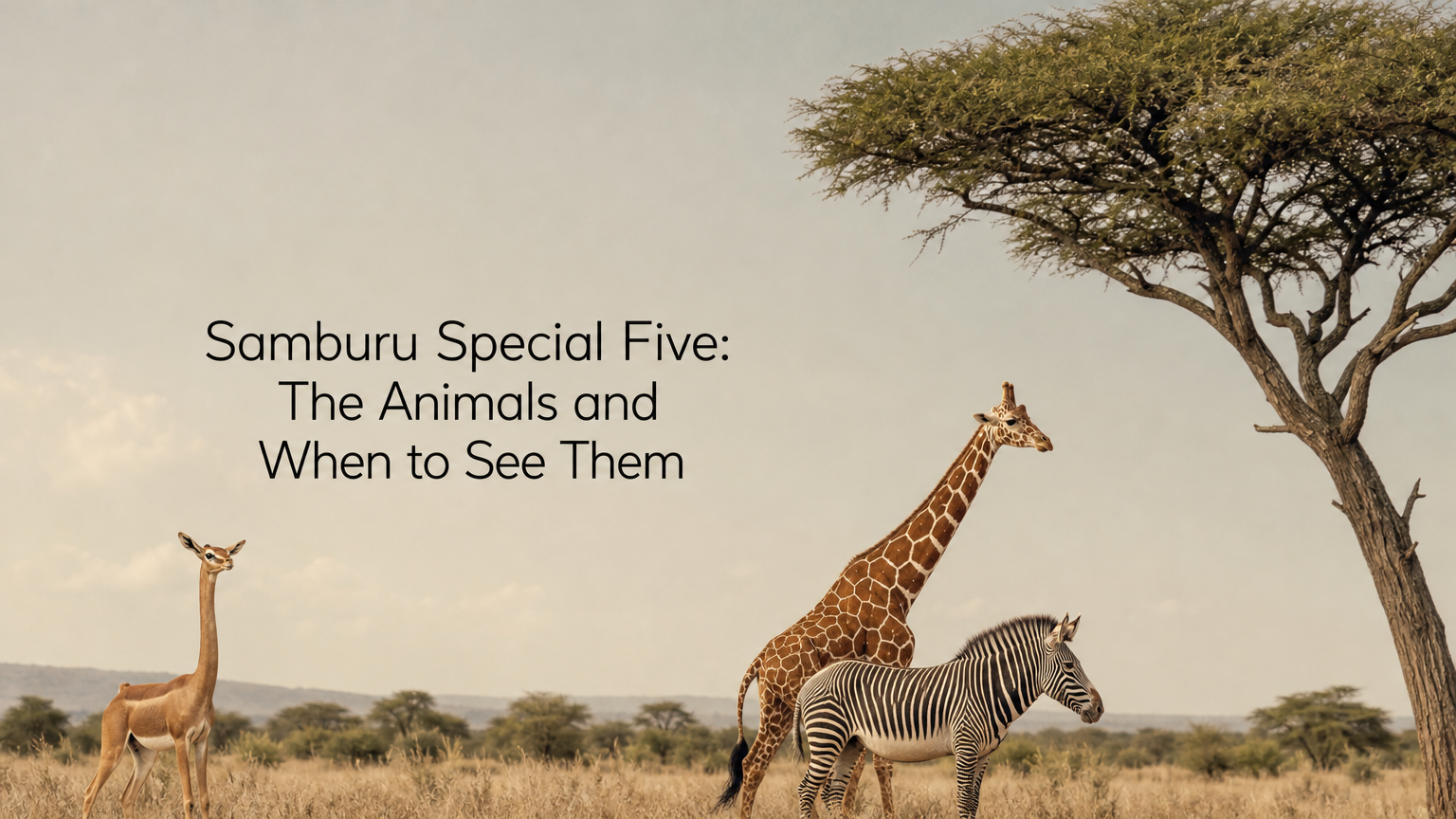
Samburu Special Five: The Animals and When to See Them
The Samburu Special Five are five animals of Kenya’s dry north that you will rarely or never see in the southern parks: the gerenuk, the reticulated giraffe, Grevy’s zebra, the Somali ostrich, and the beisa oryx. Samburu National Reserve is one of the easiest places to see all five on a single trip. You can find them year-round, but the dry months from June to October give you the best odds, because animals gather along the Ewaso Ng’iro River.
The name is a safari-trade label, not a scientific category. It borrows the idea of the Big Five and points it at species that belong to arid country. That makes it a useful checklist, because each animal is a specialist, and each one shows you how life works on Kenya’s thornbush plains.
This guide covers why the five matter, how to recognize each one, where to look inside the reserve, which months work best, and what else lives in Samburu National Reserve. Laxa Trails Safaris is a Kenya-based company, founded in 2019 by a guide with more than 14 years in the field, and we run Samburu trips from Nairobi. The advice below reflects that guiding background.
Why the Samburu Special Five matter
They matter because they show you a side of Kenya that many first-time visitors miss: a dry, thorny, river-fed country where the wildlife looks and behaves differently from the savanna animals of the south. Seeing them also puts a face on some of Kenya’s most pressured species.
A list built on place, not danger
The Big Five began as a hunter’s list of the animals hardest to take on foot. The Special Five is a wildlife-watcher’s list, and it is built on geography. It is not an official designation, but it points at something real: species whose ranges center on arid northern Kenya and the Horn of Africa.
| Big Five | Samburu Special Five | |
|---|---|---|
| Origin | Hunters’ list of the most dangerous animals on foot | Safari-trade label for dryland species |
| Animals | Lion, leopard, elephant, buffalo, rhino | Gerenuk, reticulated giraffe, Grevy’s zebra, Somali ostrich, beisa oryx |
| Range | Parks across much of Africa | Mainly northern Kenya and the Horn of Africa |
| Best for | Predators and heavyweight sightings | Species rarely or never seen in southern parks |
Why they live in the arid north
Each of the five carries an adaptation for dry country. The gerenuk gets most of its moisture from leaves. The beisa oryx tolerates heat and long gaps between drinks. Grevy’s zebra can go several days without water, though it still needs a reliable source. Their southern relatives, the plains zebra, the Masai giraffe, and the common ostrich, favor wetter grassland.

Water in this region comes mainly from the Ewaso Ng’iro River. It rises on the slopes of Mount Kenya and runs through the reserve, feeding doum palms and riverine forest in an otherwise parched landscape. The river is the reason so much wildlife concentrates here.
The Special Five are rare because they are specialists in a dry place, and the Ewaso Ng’iro River keeps that place alive.
Why their conservation status raises the stakes
Grevy’s zebra and the reticulated giraffe are both listed as endangered. The Somali ostrich is listed as vulnerable, and the gerenuk as near threatened. Pressures include competition with livestock for grazing, habitat loss, hunting, and prolonged droughts that strain already thin resources. Most wild Grevy’s zebras live in northern Kenya, with a small population in Ethiopia.
Tourism helps. Park fees and lodge stays fund the reserve and local conservancies, and they create jobs for Samburu guides and staff. A trip here is one of the more direct ways to support these species.
Meet the five animals
Each of the five has a clear look and a preferred habitat, so you can learn to recognize them before you arrive. Here they are in the order most visitors tend to meet them.
Gerenuk
The gerenuk is a long-necked antelope that stands on its hind legs to browse leaves that other grazers cannot reach. Its name is Somali for "giraffe-necked." It feeds on leaves and shoots and gets almost all its moisture from them. Only the males carry horns, and the animals often freeze motionless in thornbush before bolting.
- Look for: a slender neck, a small head, large ears, and a body standing upright against an acacia
- Status: near threatened
- Best bet: dry thornbush and scrub away from the river
Reticulated giraffe
The reticulated giraffe has large, sharply outlined chestnut patches separated by bright white lines, a much crisper pattern than the blotchier Masai giraffe of the south. It browses acacia leaves and moves in loose herds. It is endangered, with an estimated 16,000 or fewer left in the wild, and Samburu is one of the best places to see it.
- Look for: geometric patches that look like cracked tiles
- Status: endangered
- Best bet: acacia woodland and the riverbank in morning and evening light
Grevy’s zebra
Grevy’s zebra is the largest wild member of the horse family. It has narrow, close-set stripes, a white belly, large round ears, and a pale muzzle. If you see a zebra with broad stripes and small ears, you are looking at a plains zebra. Grevy’s zebras are more wary than plains zebras, so a long lens helps.
- Look for: fine stripes that stop before the belly, and big rounded ears
- Status: endangered
- Best bet: open plains and the riverbank, especially early in the day
Somali ostrich
The Somali ostrich is now treated as its own species rather than a subspecies of the common ostrich. Its neck and thighs are gray-blue instead of pink, and the males’ blue deepens in the breeding season. Like all ostriches, it cannot fly but can sprint at around 70 km/h. It often keeps its distance, so scan open ground rather than bush.
- Look for: a gray-blue neck and legs, a black-and-white male, a brown female
- Status: vulnerable
- Best bet: open grassland and dry plains
Beisa oryx
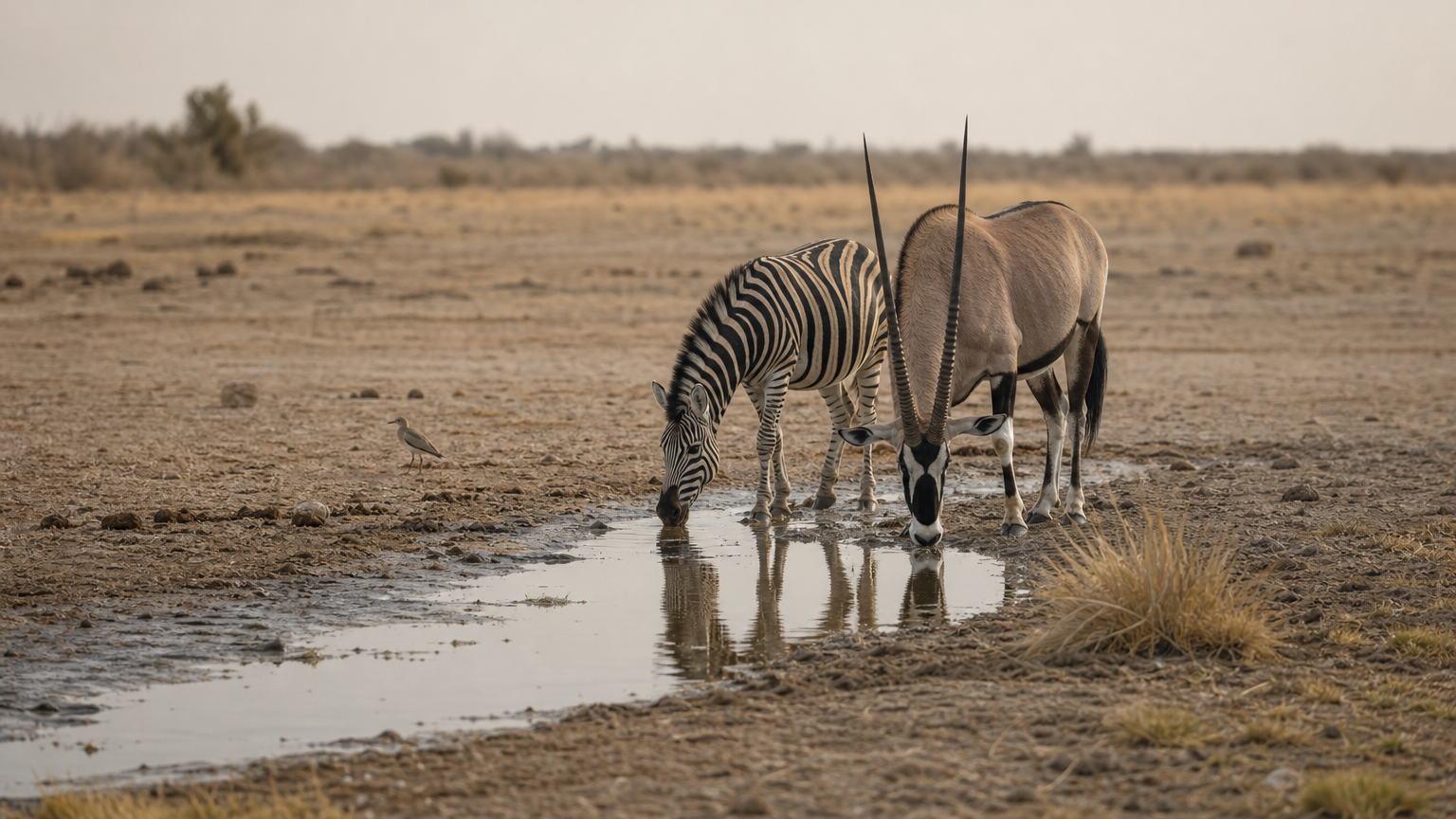
The beisa oryx is a pale gray-tan antelope with a black-and-white face and long, straight horns carried by both sexes. It lives in herds, tolerates heat well, and gets by with little drinking. It often grazes alongside zebra and tends to drift away from vehicles, so approach slowly and let your guide position the car.
- Look for: spear-like horns and bold facial markings
- Best bet: open plains and dry scrubland
- Good to know: oryx in soft morning or evening light make some of the best photos in the reserve
How to see the Special Five on safari
To see all five, base yourself near the river, stay at least two nights, and spend your drives in early morning and late afternoon with a guide who knows where animals shelter. The reserve is small, about 165 square kilometers, so you can cover its main habitats in a couple of days.
Where to look inside the reserve
Match each animal to its habitat and you will waste less time.
- Riverbank and riverine forest: Grevy’s zebra coming to drink, reticulated giraffe browsing, and elephants
- Acacia woodland and thornbush: reticulated giraffe, and gerenuk in the denser scrub
- Open plains and dry scrub: beisa oryx, Somali ostrich, and Grevy’s zebra grazing
Buffalo Springs National Reserve borders Samburu and offers similar habitat, and Shaba National Reserve lies just to the east.
Game drive habits that raise your odds
Start at first light. Animals are most active in the cool hours, and the light is best for photos. Stop often, switch the engine off, and scan slowly. Gerenuk and oryx are easy to drive past because their colors match the scrub. Binoculars and a 200 to 400 mm lens will help with the wary species.
Ask your guide what they saw the day before. Local guides track where herds were last seen, and that knowledge beats luck. Our vehicles are land cruisers or minibuses with pop-up roofs for easy game viewing.
A good guide and a quiet engine find more of the Special Five than any amount of driving.
How many days you need
Three days and two nights is enough for most visitors to see all five, but no guide can promise any specific animal. Wild animals move, and some days the ostrich simply hides. A sensible 3-day plan looks like this:
- Day one: travel from Nairobi. The overland drive is long, so you may only manage a late-afternoon game drive.
- Day two: a dawn drive and a late-afternoon drive, with a midday rest at the lodge.
- Day three: a final dawn drive for anything you missed, then the return to Nairobi.
Our 3 Days Samburu Game Reserve Wildlife Safari follows that rhythm. It runs 3 days and 2 nights from Nairobi, with game drives, full-board accommodation, park entrance fees, and nature walks led by local Samburu warriors. A Samburu village visit costs extra. If you prefer to skip the road, the 3 Days Samburu National Reserve Flying Safari uses a return flight from Nairobi, a lodge stay, and game drives in a 4×4 Land Cruiser.
Best time to see the special five in Samburu
The best time to see the special five in Samburu is the dry season from June to October. Vegetation is thin, water is limited, and animals concentrate along the Ewaso Ng’iro River. Samburu has no migration to time, so all five can be seen in any month.
Season by season
| Season | Months | What it means for the Special Five |
|---|---|---|
| Main dry season | June to October | Animals gather at the river and thin vegetation makes them easier to spot. Dusty and hot, but the best overall viewing. |
| Short dry season | January to March | Still dry, with good viewing and clear skies. |
| Long rains | April to May | Green landscape and fewer vehicles. Animals spread out, so the search takes longer. |
| Short rains | November to December | Fresh vegetation, dramatic skies, and migratory birds. Animals are more scattered. |
If you can choose freely, pick the dry months. The later weeks of the dry season tend to push animals hardest toward the river, which helps with Grevy’s zebra and giraffe.
Time of day matters more than month
Early morning and late afternoon beat any month for the Special Five. By midday the heat pushes animals into shade, and sightings thin out whatever the season.
The green seasons have their own appeal. Birdlife peaks as migrants arrive, and photographers often prefer the softer light and lush scenery. You will just spend more time looking, so allow an extra night if you travel then.
What else lives in Samburu National Reserve
Samburu National Reserve animals go well beyond the Special Five. The reserve is known for elephants, reliable leopard sightings, and a wide range of dryland birds, so you can build a full safari around it.
Big cats, elephants, and other mammals
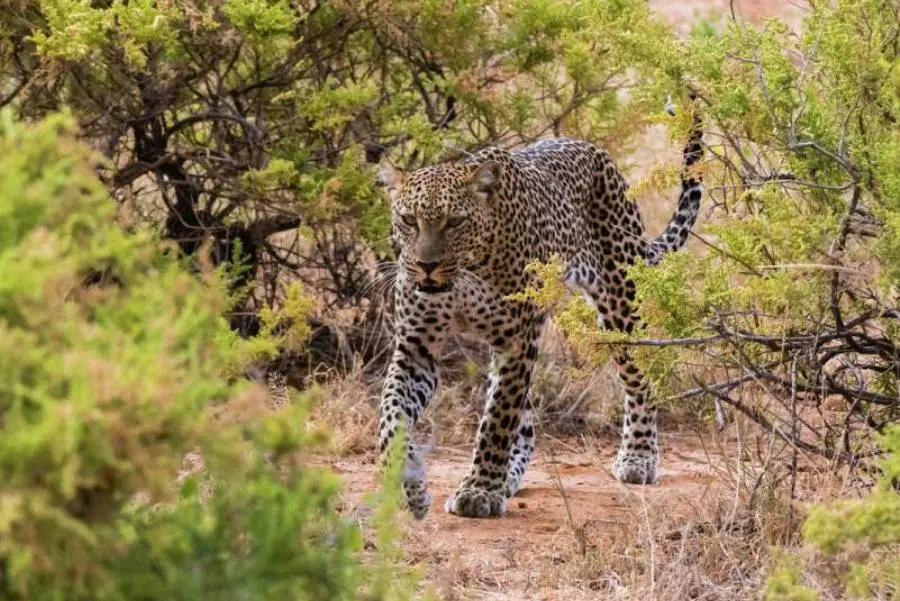
Elephants are the most visible large mammals, and the reserve is home to the headquarters of Save the Elephants, so these herds are among the most studied in Africa. Lions, cheetahs, and spotted hyenas live here, and wild dogs and the rare striped hyena turn up occasionally. For many visitors the leopard is the hardest Big Five animal to find, and the river corridor here is among Kenya’s more reliable places to look.
Dry-country antelope add to the list, including lesser kudu and the tiny Kirk’s and Günther’s dik-diks. Rhinos are essentially absent from the reserve itself, so if they are a priority, see our guide to the best places to see rhinos in Kenya and look at the nearby conservancies.
Birds worth a second look
The reserve sits between desert and savanna, so the birding is excellent. Species to watch for include the vulturine guineafowl, the Somali bee-eater, the golden pipit, and D’Arnaud’s barbet. A good guide will point out the more local species if you ask.
Samburu or Masai Mara
Neither is better, because they offer different things. The Masai Mara has the Great Migration and dense predator action. Samburu has the Special Five, fewer vehicles, and a rugged landscape shaped by the river. Many travelers pair them to get both, and we run safaris to both regions.
Seeing all five for yourself
The Samburu Special Five are the gerenuk, reticulated giraffe, Grevy’s zebra, Somali ostrich, and beisa oryx. They are special because they are dryland specialists, concentrated in northern Kenya, and under real pressure. You can see them year-round in Samburu National Reserve, with June to October offering the best odds and dawn and dusk giving the best drives.
If you want to see them with a guide who knows the reserve, start with a short trip and let your driver-guide do the tracking. When you are ready, plan a Samburu game reserve safari with Laxa Trails Safaris and tell us which animals matter most to you.