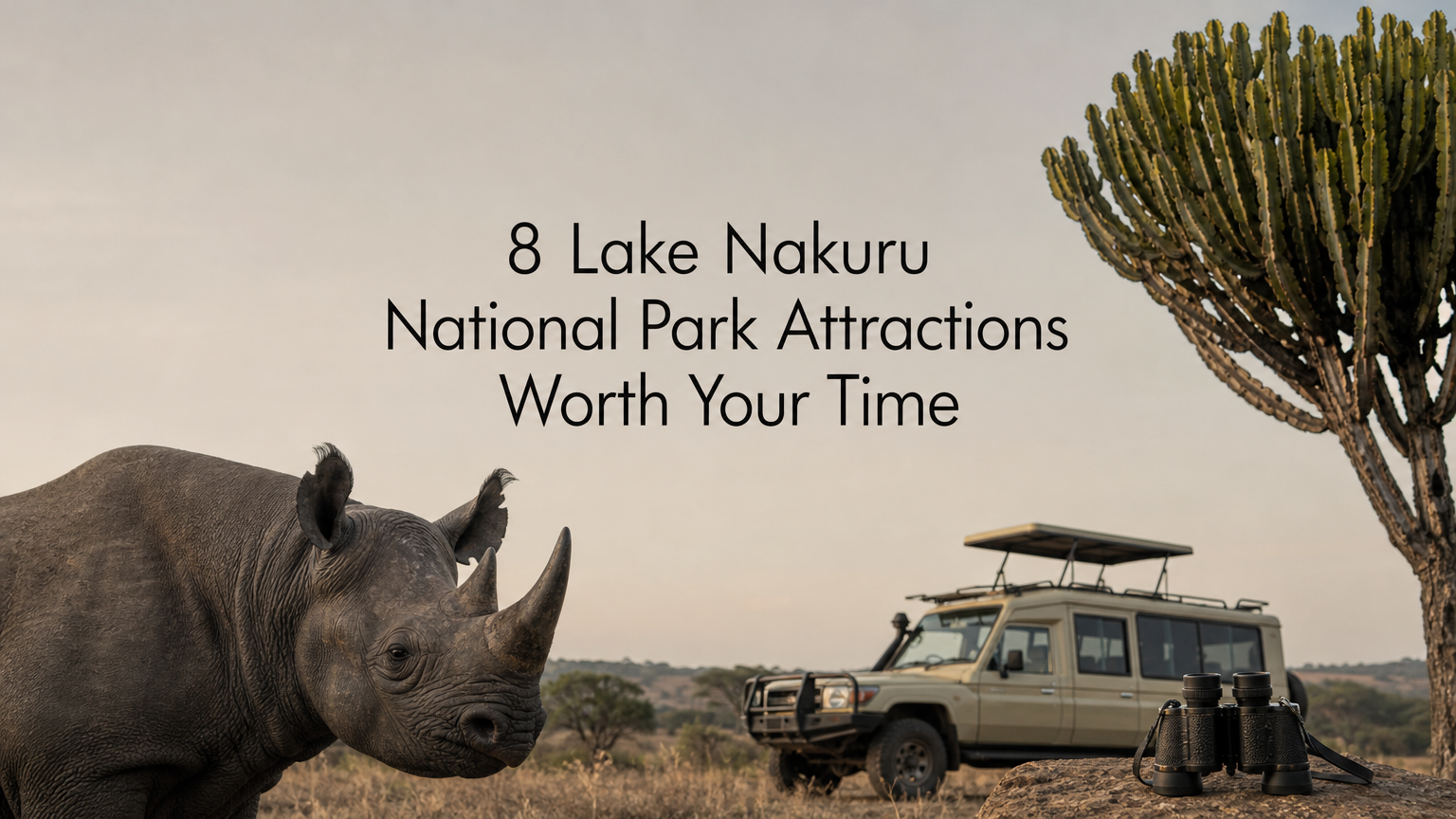
8 Lake Nakuru National Park Attractions Worth Your Time
The best Lake Nakuru National Park attractions are the flamingos on the soda lake, the rhino sanctuary, game drives for lions and Rothschild’s giraffe, the hilltop viewpoints, Makalia Falls, birdwatching and the acacia woodlands. A good pick depends on your time and interests. Birders should start at the shoreline. First-time safari visitors should put rhinos and a game drive first. Photographers should add the viewpoints at sunrise or late afternoon.
Only 188 square kilometers wide and about 170 kilometers northwest of Nairobi, the park is easy to underplan. Many visitors drive one loop, see a pink shoreline and leave, then learn later about the viewpoint or waterfall they passed. Most lists also skip the practical part: when each sight works best and what to ask your guide.
This guide walks through eight things to see and do, with where to go, when to go and how to get more from each. We are Laxa Trails Safaris, a Kenya-based company founded in 2019 by a guide with more than 14 years in the field, so the tips come from how these routes run on the ground.
1. Flamingos on the soda lake
The flamingos are the park’s best-known sight and the reason many travelers come. The alkaline lake draws greater and lesser flamingos to feed in the shallows, but numbers change with lake levels and food supply. Ask your guide what the shoreline looks like before you plan around it.
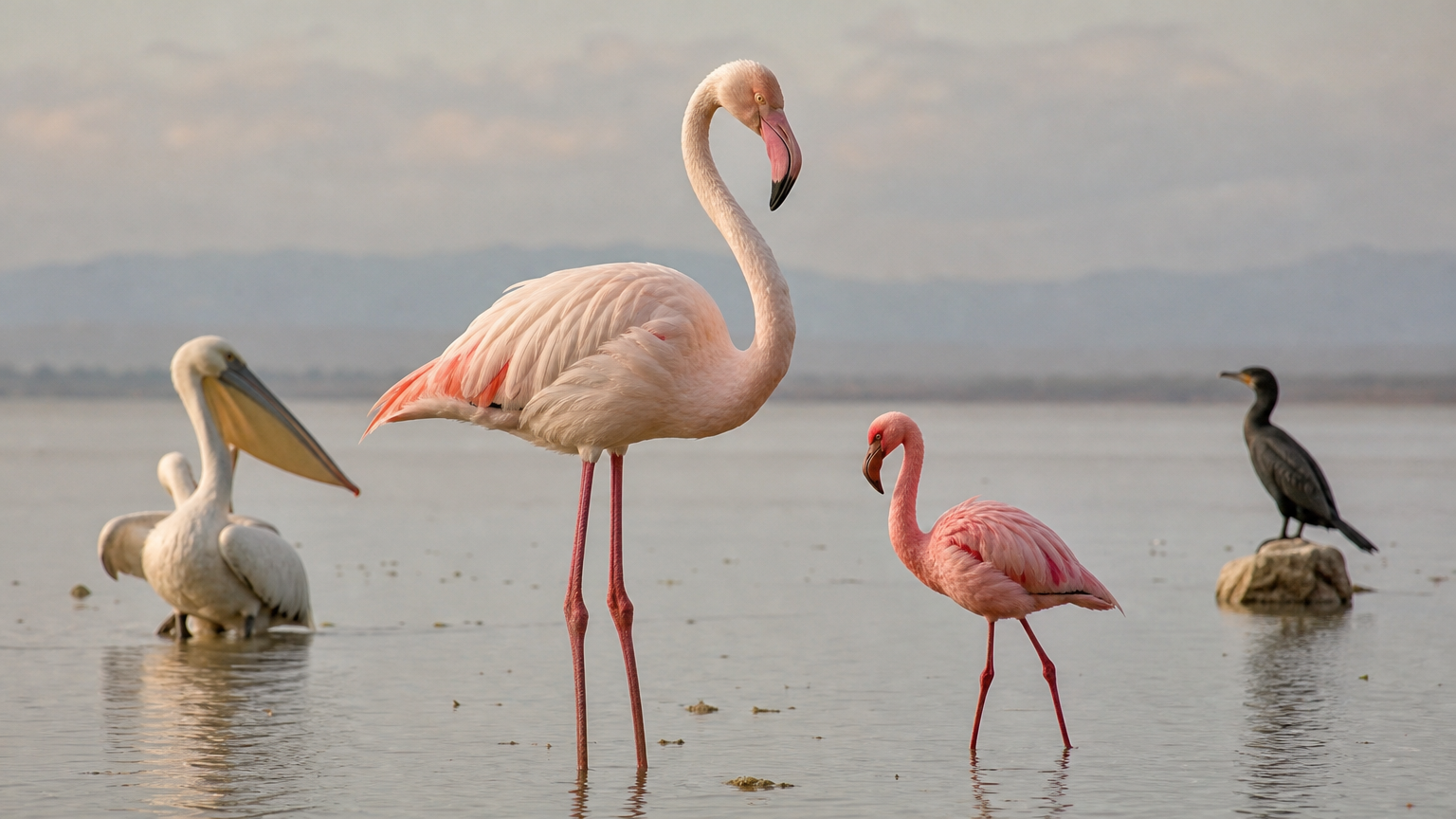
A pink shoreline is a bonus, not a promise, so plan the day around more than the flamingos.
What you will see
Flamingos feed on algae and tiny organisms in the alkaline water, so they gather where food is richest. In some years the flocks move to other Rift Valley lakes, so a sparse year is not a failed visit, only a different one. Telling the two species apart adds to the fun:
- Greater flamingo: taller, paler pink, pink bill with a black tip
- Lesser flamingo: smaller, deeper pink, darker bill
- Pelicans and cormorants often share the same shoreline
Where and when to go
Scan from the lakeside roads and lookouts, where you can see the water without flushing the birds. Early morning gives soft light and calm air. Migratory waders from Europe and Asia add variety in the northern winter.
- Best hours: first light, then late afternoon
- Best season for variety: roughly November to April
How to get the most from it
Stay in the vehicle except at designated stops. Walking toward a flock only pushes it off. The thickest groups often stand far out, so bring binoculars and a zoom lens.
- Binoculars: 8×42 is a good all-round choice
- Lens: 200 to 400 mm for flocks on the water
- Clothing: neutral colors, plus a layer for early mornings
2. The rhino sanctuary
Lake Nakuru is one of the best places in Kenya to see black and white rhinos, because the fenced park works as a rhino sanctuary. Sightings are never guaranteed, but a full day of driving gives you good odds of at least one.
Rhinos are the strongest reason to choose Nakuru over a larger park.
What you will see
The two species look alike from a distance, so learn the difference before you go. Both are endangered, which makes every sighting here worth a long look.
- White rhino: a grazer with a wide, square lip, usually on open grassland
- Black rhino: a browser with a pointed, hooked lip, favoring bush and woodland edges
- Both carry two horns, so the lip is the more reliable clue
Where and when to go
Rhinos move between open grassland and bush, so cover both habitats instead of waiting at one spot. They are most active in the early morning and late afternoon, which are also the best hours for photography.
Dry months improve visibility because the grass is shorter. In the wet season, tall grass can hide a white rhino until you are close.
How to get the most from it
Keep to the vehicle and a safe distance. Rhinos see poorly but hear and smell well, and a startled animal can charge. Switch off the engine and wait quietly, since a still vehicle often gets the closest views.
If rhinos are your priority, our 5-day safari through Lake Naivasha, Hell’s Gate, Lake Nakuru and the Maasai Mara names rhino tracking in Lake Nakuru as part of the itinerary. Ask your driver-guide to build the day around it.
3. Game drives for lions, leopards and giraffes
A game drive is the core Lake Nakuru activity. The park is small enough that one loop crosses shoreline, grassland and woodland. Expect lions, buffalo, zebra, waterbuck and Rothschild’s giraffe, and treat a leopard as a lucky bonus.
Because the park is compact, a good guide matters more than a long route.
What you will see
Yes, there are lions in Lake Nakuru National Park, and they sometimes rest in acacia trees. Rothschild’s giraffe, an endangered subspecies, is a highlight. You will not find elephant herds here, so do not expect a full Big Five from this park alone.
- Predators: lion, elusive leopard, spotted hyena, jackals, and smaller carnivores such as civet and genet
- Grazers: buffalo, zebra, waterbuck and warthog
- Primates: baboons and monkeys
- Water: hippos at the lake’s edges
Where and when to go
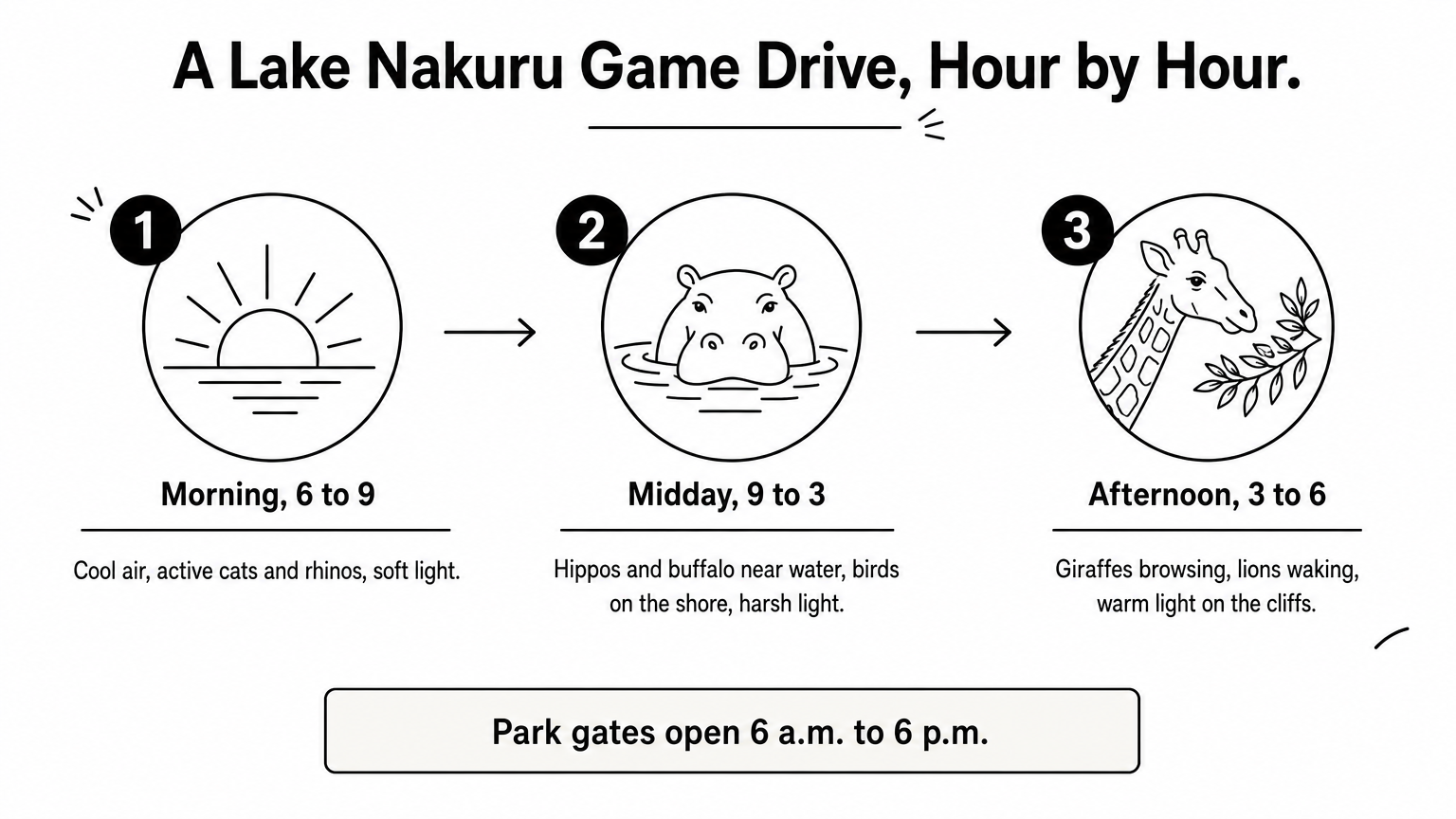
The gates open 6 a.m. to 6 p.m., so use both ends of the day.
| Time | What it favors |
|---|---|
| 6 to 9 a.m. | Cool air, active cats and rhinos, soft light |
| 9 a.m. to 3 p.m. | Hippos and buffalo near water, birds on the shore, harsh light |
| 3 to 6 p.m. | Giraffes browsing, lions waking, warm light on the cliffs |
June to October is the most reliable window, and January to March also works well. Wet-season visits bring greener scenery and are still worthwhile.
How to get the most from it
Choose a pop-up roof vehicle, because it lets everyone stand and shoot in every direction. We use a Land Cruiser jeep or a minibus with a pop-up roof, and we suggest no more than seven guests per vehicle so everyone keeps a window seat.
Budget for park fees too. Entry depends on residency and changes over time, so check the current Kenya Wildlife Service schedule. Or pick a package that already includes park fees, as our 4-day, 5-day Big Five and 6-day safaris do.
4. Hilltop viewpoints over the lake
The ridge lookouts give you the view no track can: the whole lake and plains laid out below. The best known are Baboon Cliff, Out of Africa and Lion Hill, with Enasoit and Honeymoon hills as quieter options.
Climb for the view, then look down for the pale line of flamingos.
What you will see
From the heights, the shoreline reads as a pale ribbon against green woodland and the rocky escarpment that frames the park. The scale of the place makes sense from up here.
- The curve of the lake and its pale shoreline
- Euphorbia trees silhouetted against the escarpment
- Baboon troops near the cliff that carries their name
Where and when to go
These lookouts are reached by park tracks, so ask your guide which are open and worth the time on your day. Sunrise and late afternoon give long shadows and warm color, and clear mornings after rain give the sharpest air.
Plan the viewpoints between wildlife stops, not as a separate outing. A full loop with two lookouts usually fits in a morning.
How to get the most from it
Keep food out of sight, since baboons are quick and bold. Stay well back from cliff edges and keep children close at every stop.
The park sits at 1,756 meters, cooler than most Kenyan parks, so the wind on a ridge can feel chilly. Carry a light jacket, plus a wide lens for the panorama.
5. Makalia Falls and the riverside forest
Makalia Falls is the park’s waterfall, and it looks its best after the rains. Treat it as a quiet stop between game drives, not a destination for the whole day. A campsite nearby also makes it a good base for birdwatching.
Visit Makalia after rain and it is a highlight; in the dry months it is a pleasant pause.
What you will see
A cascade over rock, framed by trees and thick vegetation. The cool greenery attracts birds and monkeys, a real contrast to the open lake shore.
Flow varies strongly with the season. In dry months the water can drop to a trickle, and then the shaded setting is the main draw.
Where and when to go
Kenya’s long rains run from March to May and the short rains from October to December, and the falls are fuller after both. Ask your guide about recent rainfall before you commit time to the stop.
- Fullest: after the March to May and October to December rains
- Quietest: dry months, when you may have the place to yourself
How to get the most from it
Pair the falls with a morning game drive so the stop breaks up the day. Wear sturdy shoes. Foot access inside the park is limited to designated areas, often with a ranger, so ask before you walk.
If you want to sleep inside the park, ask us about options. Our safaris range from basic camping to luxury tented camps and lodges, depending on your budget.
6. Birdwatching beyond the flamingos
More than 400 bird species have been recorded in the park, so Nakuru rewards birders well beyond the flamingo flocks. Shore, woodland and cliffs each give a different checklist, which makes the park a strong half day for beginners and keen listers alike.
Four hundred species in 188 square kilometers makes Nakuru a birder’s park, not just a flamingo stop.
What you will see
Waterbirds dominate the shore, while raptors and woodland birds fill the trees and cliffs. A typical morning can produce a long list without leaving the vehicle.
- Waterbirds: pelicans, cormorants, herons, storks and geese
- Raptors: fish eagles and other eagles
- Woodland and shore: kingfishers
- Open ground: ostriches
Where and when to go
Work the shore for waterbirds, then move to woodland edges for kingfishers and raptors. Birds are most active in the first hours after sunrise, and the light is better for photographs then too.
Northern-winter migrants swell the lists from about November to April, so a visit in those months adds species you will not see in mid-year.
How to get the most from it
Tell your guide you are a birder when you book, so the schedule can favor early starts and slower stops. Pick one habitat per hour instead of chasing every small bird.
- Binoculars with a steady, wide field of view
- A field guide or app covering East African birds
- A notebook for your list
7. Acacia and euphorbia woodlands
The woodlands are the park’s quiet side, where acacia forest and candelabra-shaped euphorbia trees replace the open shore. This is where you find leopards, pythons and browsing giraffes, and where the park feels least like a lake visit.
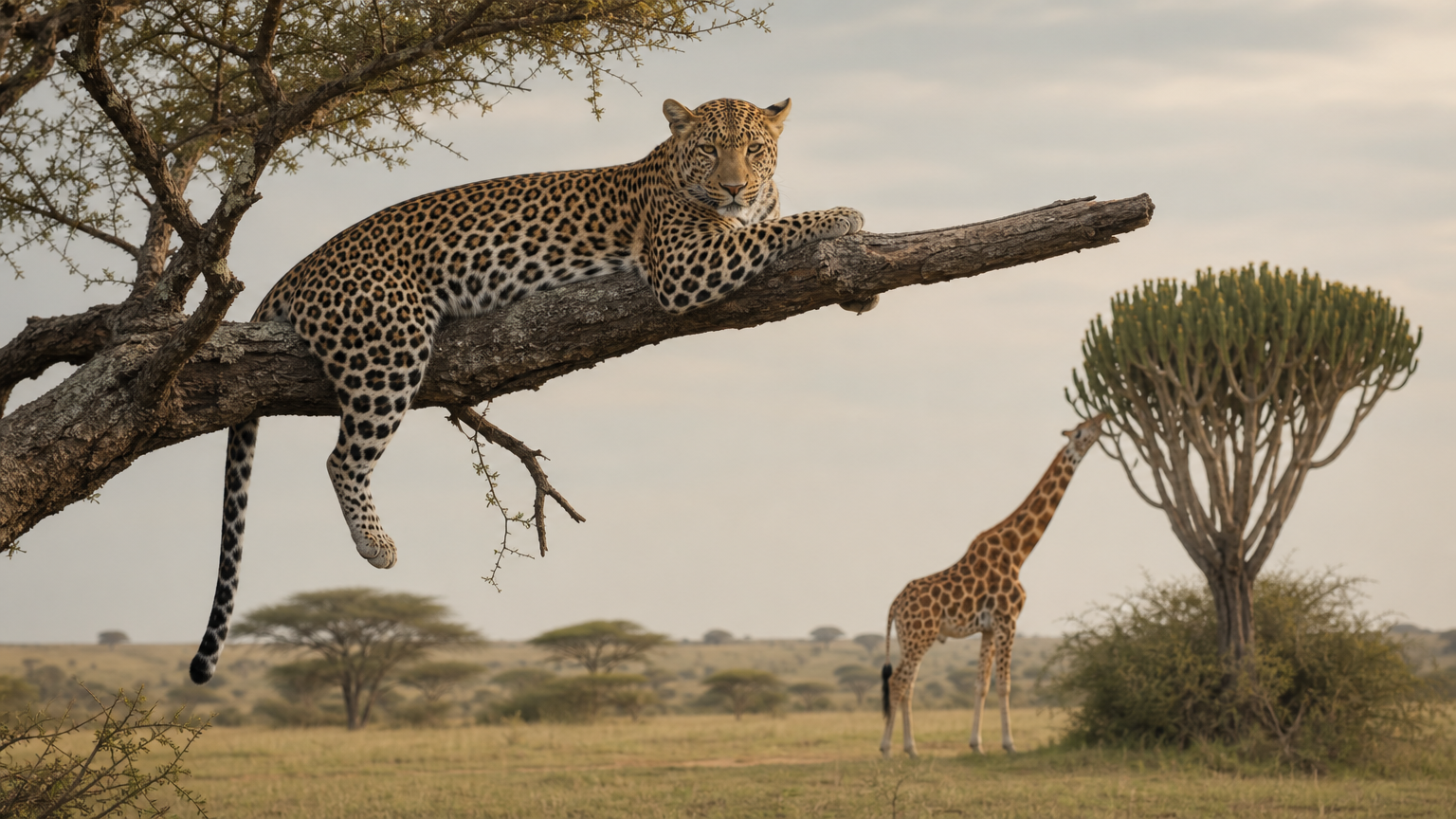
Look up as often as you look out, because the woodland hides its wildlife in the branches.
What you will see
Woodland sightings are rarer than shoreline ones, so patience pays. The reward is behavior you do not see on open ground.
- Leopards resting on branches, though they are elusive
- Pythons draped in trees, an occasional find
- Rothschild’s giraffes browsing at canopy height
- Baboons and monkeys moving through the trees
Where and when to go
Tracks that leave the shore take you into the shade of the woodland. Early morning is the best time for leopards, which are more active in cool hours.
Midday heat sends animals into shade, so the woodland is also a good midday option when the open grassland goes quiet.
How to get the most from it
Scan the branches, not only the ground. Leopards and pythons blend into bark, so ask the driver to stop and wait for a few minutes where the trees thicken.
Wear neutral colors such as khaki, brown or olive, and bring insect repellent for dawn and dusk. Binoculars help you pick out a tail or a coil before the animal moves.
8. Pairing Nakuru with Naivasha and Hell’s Gate
Nakuru works best as one stop on a longer route. The park is small, and its neighbors add what it lacks: boats, walking and cycling. Lake Naivasha, Hell’s Gate and Menengai Crater all sit nearby and turn a one-park trip into a full itinerary.
Nakuru gives you rhinos and flamingos; its neighbors give you the activities on foot or on water.
What you will see
Each neighbor adds a different activity, so you can build a route around what you enjoy.
| Stop | What you can do |
|---|---|
| Lake Nakuru National Park | Rhinos, flamingos, game drives, viewpoints |
| Lake Naivasha | Boat ride, walking safari at Crescent Island |
| Hell’s Gate National Park | Walking and cycling among cliffs and gorges |
| Menengai Crater | Viewpoint over a volcanic crater near Nakuru town |
Where and when to go
Most routes run from Nairobi to Naivasha and Hell’s Gate, then on to Nakuru, and continue to the Masai Mara or Amboseli. Allow a full day for Nakuru if you want rhinos, a viewpoint and the woodland.
Many lists of Kenya’s top parks lead with Masai Mara, Amboseli and Tsavo. Nakuru earns its place as the compact add-on with the best chance of rhinos.
How to get the most from it
Our packages that include Nakuru give you a ready route.
- 4 days: Lake Naivasha, Lake Nakuru and the Masai Mara, full board, park fees included
- 5-day Big Five Kenya safari: $1,460 (from $1,550), with park entry fees, English-speaking driver-guide, meals and bottled water
- 5 days via Hell’s Gate and Lake Nakuru rhino tracking: $1,765 (regular $1,800)
- 6 days adding Amboseli: $2,195 (from $2,315), all inclusive
International flights, visa fees and tips are not included, and we strongly recommend travel insurance before you travel.
Planning your Lake Nakuru visit
Lake Nakuru packs a lot into a small park: flamingos on the shore, rhinos on the grass, lions and giraffes on the drive, views from the ridges, a waterfall, hundreds of bird species and quiet woodland. Pick the sights that match your interests, time them for early morning or late afternoon, and add Naivasha or Hell’s Gate if you want walking, cycling or a boat ride.
When you are ready, plan your Lake Nakuru safari with Laxa Trails Safaris and we will shape the route around the sights that matter most to you.