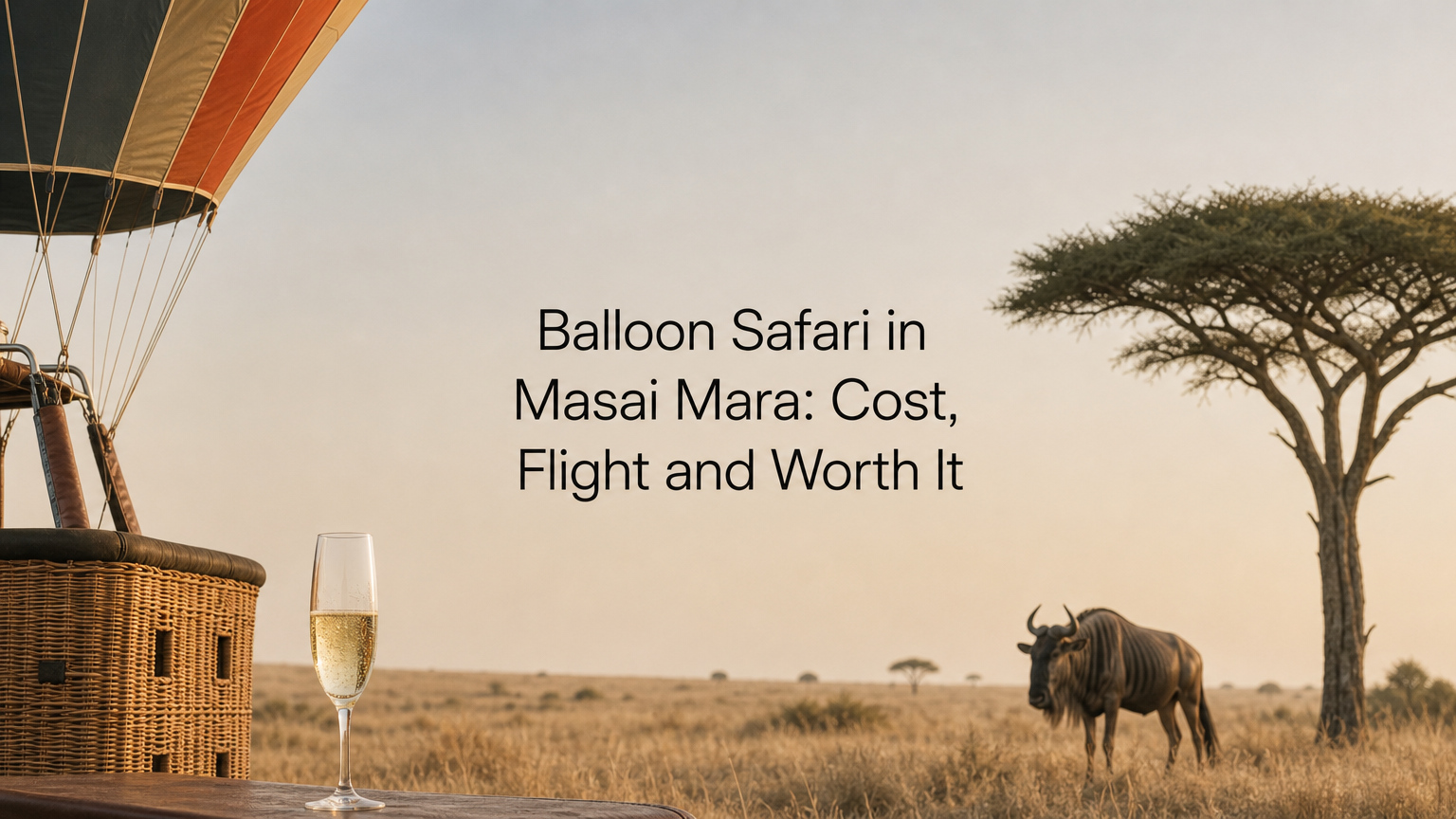
Balloon Safari in Masai Mara: Cost, Flight and Worth It
A balloon safari in Masai Mara is a sunrise flight in a hot air balloon over the reserve’s plains, rivers and wildlife, followed by a champagne-style breakfast in the bush where you land. You spend about an hour in the air, the whole morning takes four to five hours, and in 2026 a seat typically costs $450 to $550 per adult. For most travelers it is worth booking, as long as you stay at least two nights in the Mara and accept that it gives you a view, not close-up animal encounters.
This guide answers the questions you probably have before you pay. It explains why people fly and who should skip it, how to plan and book the flight, what the morning feels like hour by hour, and what it costs in dollars and shillings. It also covers the best months to go, what happens when weather cancels a flight, and the safety rules, age limits and clothing that matter on the day.
Laxa Trails Safaris is a Kenya-based safari company, founded in 2019 by a guide with more than 14 years in the field.
Why a balloon safari in Masai Mara is worth considering
A Masai Mara hot air balloon safari is worth it when you want scale, silence and a new angle on a place you will otherwise see from a vehicle. It does not replace game drives, and that distinction decides whether you will love it or feel let down.
How the flight works
A hot air balloon cannot be steered. The pilot controls only height, firing the burner to rise and venting hot air to sink. Wind blows in slightly different directions at different heights, so a good pilot hunts for the right wind layer to nudge the balloon toward the best scenery. The balloon otherwise drifts with the air, which means no two flights follow the same route. Altitude ranges from just above the treetops to a few hundred feet.
Ground crews follow in vehicles and meet you at the landing spot, wherever it turns out to be. You stand in a large basket divided into compartments, and flights often carry 12 to 16 passengers. Expect a shared experience, not a private one.
What you gain that a vehicle cannot give
From the air you see how the Mara fits together. Riverine forest follows the Mara River, savanna rolls out to the escarpments, and herd movements that look random from the ground form clear patterns. Between bursts of the burner the basket is quiet, so you hear the bush itself, including elephants trumpeting and birds waking up.
Low sunrise light turns the grass gold, which photographers value. From July to October, a flight can pass over wildebeest, zebra and gazelle herds, and the sheer size of the migration only makes sense from above.
What it will not give you
The balloon moves with the wind, so it cannot stop above a lion or follow a leopard. A game drive does those things well. Here is how the two compare.
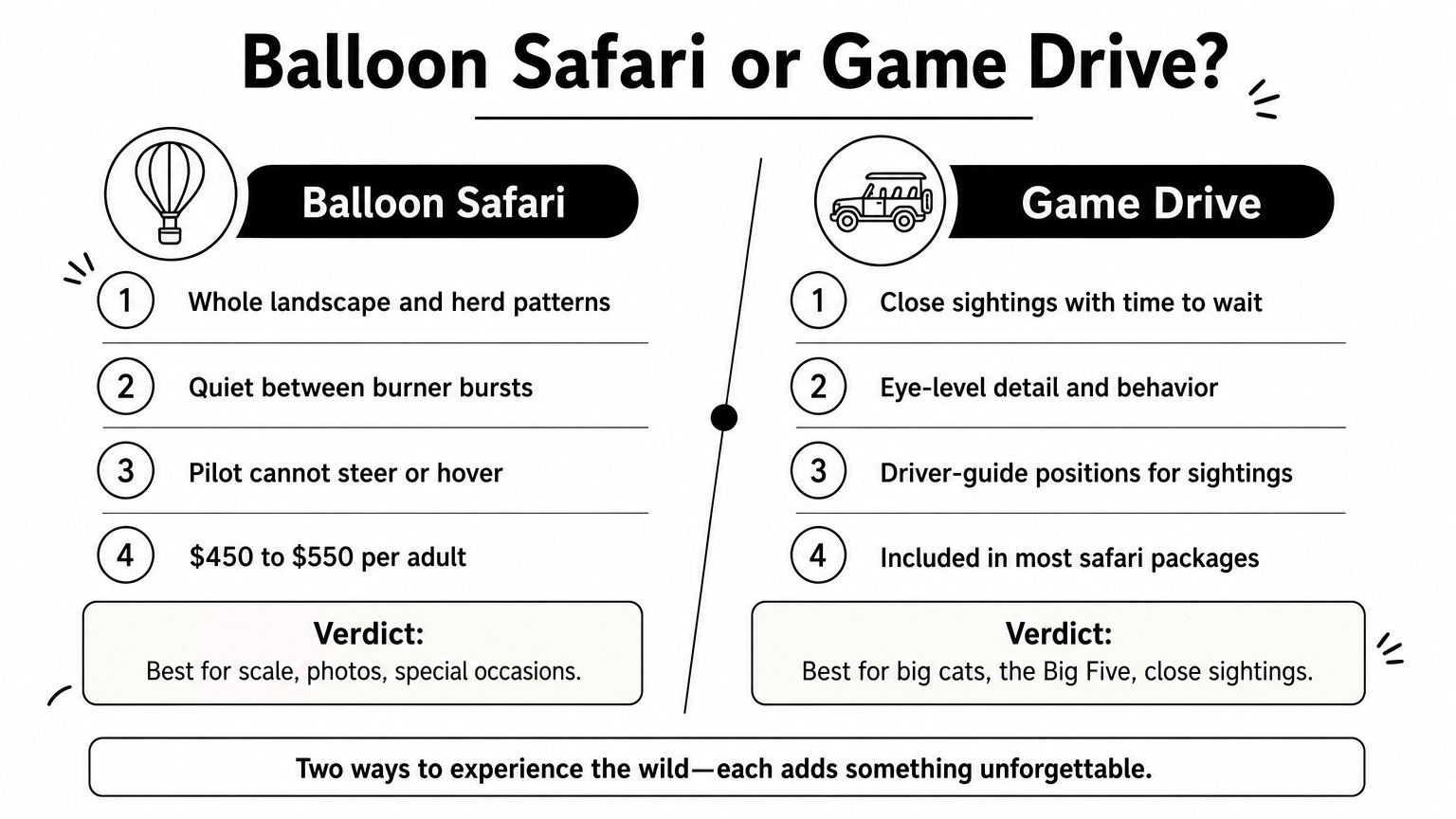
| Balloon safari | Game drive | |
|---|---|---|
| Distance to animals | Usually well above them | Close, with time to wait and watch |
| Control | Pilot cannot steer or hover | Driver-guide positions for sightings |
| Perspective | Whole landscape and herd patterns | Eye-level detail and behavior |
| Sound | Quiet between burner bursts | Engine and radio |
| Time | About an hour airborne, 4 to 5 hour morning | Half day or full day |
| Cost | $450 to $550 per adult | Included in most safari packages |
| Best for | Scale, photos, special occasions | Big cats, the Big Five, close sightings |
If you can only afford one, choose the game drives. If you can afford both, fly on your second or third morning, after you have seen the Mara from the ground and the aerial view makes more sense.
The balloon gives you the best view in the Mara, and the game drive gives you the best encounter.
How to plan and book your Masai Mara balloon safari
Book the flight through your tour operator or lodge, several months ahead if you travel between July and September, and plan at least two nights in or near the reserve. That gives you a backup morning if wind or cloud cancels the first flight.
A six-step plan
Follow these steps in order, because each one depends on the one before it.
- Pick your dates. Flights run year-round, but July to October gives the most dramatic views.
- Choose a camp near the launch site. Transfers can take from 15 to 45 minutes, so a distant camp means an even earlier alarm. Ask which launch site your camp uses.
- Plan two nights or more in the Mara. Put the balloon on the second morning and keep the third as a spare.
- Reserve early. Baskets are limited and July through September flights sell out well before the season, so book as soon as your dates are fixed.
- Get inclusions and the weather policy in writing. Check transfers, breakfast, landing fees and whether a cancelled flight means a refund or a rebooking.
- Take out travel insurance. We strongly recommend it for every safari, and it matters more for a prepaid, weather-dependent activity.
Who runs the flights
Operators listed for the reserve include Balloon Safaris Limited, which describes itself as a pioneer of ballooning in Kenya’s Mara, plus Governors’ Balloon Safaris, Skyship Co. Balloon Safaris and Hot Air Safaris. Some lodges, including Governors’ Camp and Angama Mara, also offer flights to their guests.
In practice your camp location decides which operator you fly with, because the operator has to collect you before dawn. Compare offers on price, inclusions, group size and refund terms instead of on brand names.
Booking it alongside a safari
Booking through the company that arranges your safari keeps the transfers, the wake-up call and the return to camp in one plan. On our 4-Day Masai Mara Great Wildebeest Migration Safari and our 7-Day Masai Mara Great Wildebeest Migration Safari, the hot air balloon safari is listed as an excluded activity. Our packages cover accommodation, meals, park entrance fees and game drives, and the balloon is an extra on top.
When you ask for a quote, say you want a balloon morning and ask which nights are spent in the reserve. The 4-day migration trip runs three nights with two full game-viewing days, which leaves room for a flight plus a backup morning. Our consultants answer quote requests with details, and we can also customize an itinerary around your plans.
Book the balloon for your second Mara morning and keep a third in reserve, so one cancelled flight does not end your chance.
What a Masai Mara balloon flight is like, hour by hour
The whole experience runs four to five hours, from a pre-dawn wake-up call to a mid-morning return to camp. The flight itself is the shortest part.
The morning at a glance
Times vary by camp and by sunrise, but the shape of the morning stays the same.
| Time | What happens |
|---|---|
| 4:00 to 5:00 am | Wake-up call and pick-up from your camp in the dark |
| Before sunrise | Arrival at the launch site, hot coffee or tea, safety briefing |
| Around sunrise | Crew inflates the balloon (about 20 to 30 minutes), then lift-off |
| About an hour | Flight, with the pilot changing height to find wind and views |
| After landing | Bush breakfast with a champagne-style toast |
| Mid-morning | Transfer, or a game drive, back to camp |
Watch the inflation, because it is part of the show. The envelope fills in the half-light and you board the basket once it stands upright. Most people arrive sleepy and are wide awake by lift-off.
In the air
The ground drops away with no sense of speed. The pilot rises to treetop height, then climbs when the light and the wind allow. You may drift over the Mara River, thickets that open onto plains, and herds scattered across the grass.
Do not expect a game drive in the sky. Sightings depend on what lies under your path and how high you happen to be. Some flights pass elephants, giraffes and big herds, while others show impala, zebra and a lot of scenery. Binoculars help.
Landing and breakfast
Before landing, the pilot briefs you on bracing in the basket. Touchdown can be soft or can involve a short slide across the grass, and it is normal either way. Hold the handles and follow the pilot’s call.
The crew then sets up breakfast in the open, usually on tables in the bush with the balloon deflating nearby. Food is a hearty buffet-style meal and the toast is a celebration, not a fine-wine experience. Most operators then drive you back to camp, sometimes with a game drive on the way.
The flight is about an hour, but the dawn light, the quiet and the bush breakfast make the whole morning.
What a Masai Mara hot air balloon safari costs
A Masai Mara hot air balloon safari typically costs $450 to $550 per adult in 2026, and some quotes reach $600. Price depends on the operator, the season and what is bundled in. At around 129 Kenyan shillings to the dollar, $450 to $550 is roughly KES 58,000 to 71,000, but exchange rates move, so check on the day you pay.
What the price covers
Most quotes include these items, but confirm each one before you pay:
- The flight of roughly one hour in the air
- Transfer from your camp or lodge to the launch site
- A champagne-style bush breakfast
- Transfer back to camp
- Landing or conservancy fees
Tips for the pilot and crew are customary and usually extra, and your driver-guide can tell you what is normal. If you are not staying in the reserve, ask whether a park entry fee applies to the return drive.
The price looks steep until you count what sits behind each flight. A licensed pilot, a ground crew, fuel, recovery and transfer vehicles and a conservation fee all come out of the ticket. That is why a seat costs more than most other safari activities.
What it adds to your trip budget
Because our Masai Mara packages exclude the balloon, you pay for it on top of your safari price. Here is a worked example for two travelers taking our 3-Days Masai Mara, Lake Naivasha Budget Safari, listed at $650 per person.
| Item | Per person | Two travelers |
|---|---|---|
| 3-day budget safari | $650 | $1,300 |
| Balloon flight, low estimate | $450 | $900 |
| Balloon flight, high estimate | $550 | $1,100 |
| Total with balloon | $1,100 to $1,200 | $2,200 to $2,400 |
The flight adds roughly 70 to 85 percent to the cost of that short trip. Tips and any drinks come on top. If that share feels too high, spend the money on an extra game-drive day instead, and add the balloon on a longer trip such as the 4-day migration safari, where it is a smaller part of the total.
Treat the balloon as a $450 to $550 extra per person on top of your safari, and budget tips on top of that.
Best time to fly and what happens if the weather turns
The best time for a balloon safari in the Masai Mara is July to October, when the migration herds are in the reserve. The flight is still worth doing in other months, but wildlife, crowds and cancellation risk change through the year.
Season by season
| Season | Months | What to expect |
|---|---|---|
| Migration | July to October | Herds of wildebeest and zebra, the busiest bookings, the earliest sell-outs |
| Dry season | January to March | Clear skies, good visibility, fewer visitors |
| Long rains | April and May | Green scenery, wildlife more dispersed, the most weather risk |
| Short rains | November to early December | Mixed weather, good resident wildlife |
Our own migration safaris cite July to September for herd viewing, and river crossings are most reliable in those months. Outside them, you still get the landscape and the light, so set expectations accordingly.
If the flight is cancelled
Balloons fly only when wind, visibility and rain allow it. The pilot makes the call at dawn, and your camp passes it on. A cancellation is a safety decision, not a service failure.
Operators commonly rebook you on the next available morning or refund you if you cannot stay longer. This is why two nights in the Mara matters. Get the policy in writing before you pay and check that your travel insurance covers prepaid activities.
A written refund or rebooking policy and a spare morning are your best protection against a cancelled flight.
Safety, age limits and what to wear
Balloon safaris in Kenya are regulated by the Kenya Civil Aviation Authority, flown by licensed pilots and preceded by a safety briefing. The real questions for you are age, fitness and what to carry.
Who should check before booking
Operators set their own rules, so ask for them in writing. Children are generally allowed only if they are tall enough to see over the basket rim, commonly about 120 cm, and some operators set a minimum age of around 6 to 7. Pregnant passengers are normally advised against flying.
Boarding means stepping over a high basket rim. You stand throughout the flight, and landings can be abrupt. If you have back, knee or hip trouble, or a strong fear of heights, talk to your doctor and the operator first. They have seen most situations and will give a straight answer.
What to wear and bring
Mornings in the Mara are cold before the sun climbs, then warm up fast. Dress in layers you can remove at breakfast.
- A fleece and a light windproof jacket
- Closed, comfortable shoes with grip
- A hat and sunscreen for the breakfast in the open
- A phone or compact camera on a strap, fully charged
- Binoculars, if you carry a small pair
Leave heavy camera bags and spare lenses at camp. Gear gets in the way during landing and can break. Take as little as you can.
Seeing the Mara from above
A balloon safari in the Masai Mara is a dawn flight of about an hour that costs $450 to $550 per adult. It gives you scale, quiet and light, and it is best in migration season. It does not give you close animal encounters, so keep game drives as the core of your trip. Book early, stay two nights or more, and get the weather policy in writing.
If you decide to fly, plan the whole safari around it. Our consultants can build a Masai Mara itinerary with the right nights in the reserve, so request a Masai Mara safari quote from Laxa Trails Safaris and tell us you want a balloon morning.