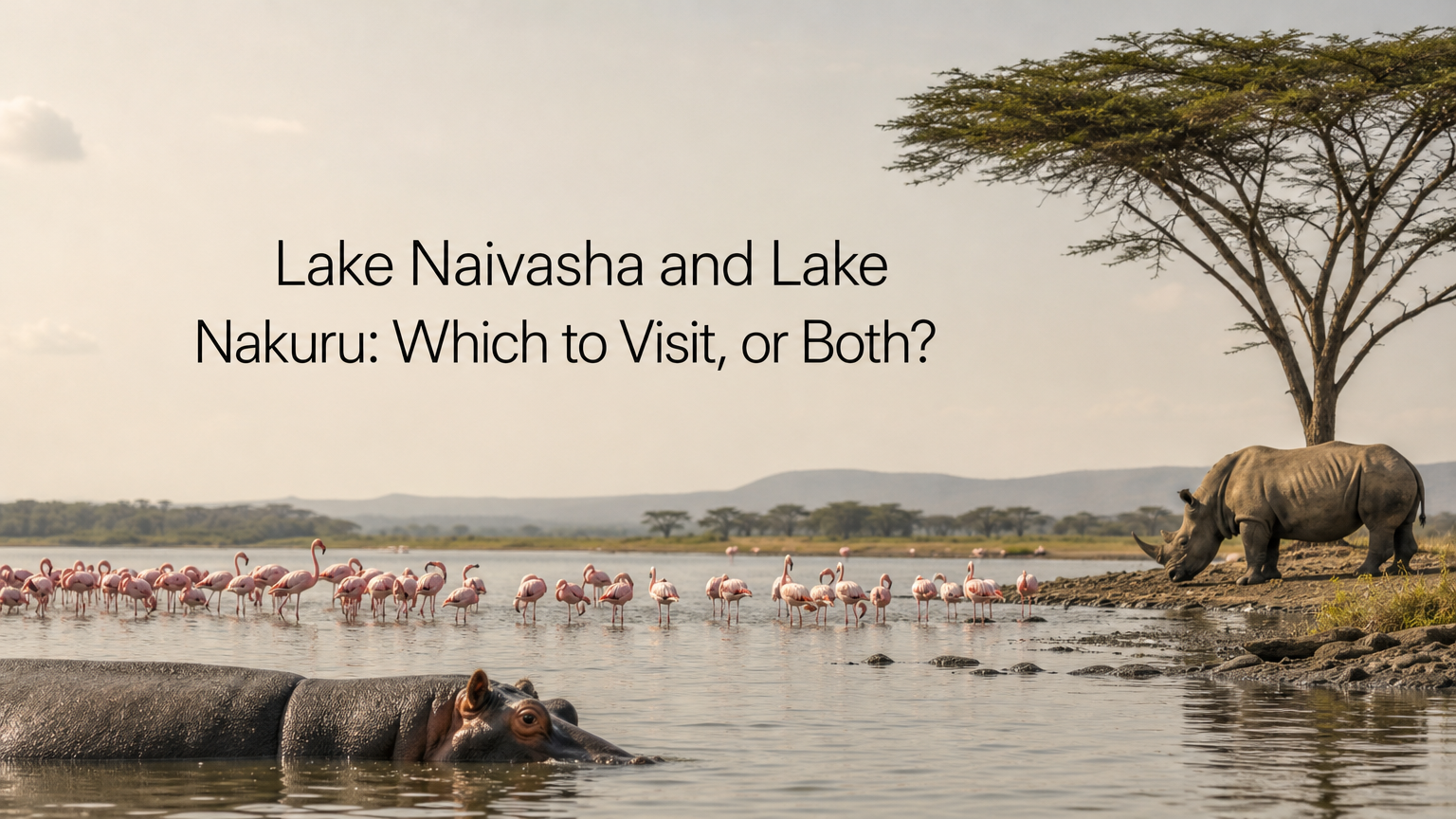
Lake Naivasha and Lake Nakuru: Which to Visit, or Both?
Lake Naivasha and Lake Nakuru are two lakes in Kenya’s Great Rift Valley, about 60 km (37 miles) apart, and they give you two very different safari days. Naivasha is a freshwater lake known for hippos, fish eagles and boat rides. Nakuru is an alkaline soda lake inside a fenced national park, known for flamingos and for both black and white rhinos. You can see both in two days from Nairobi, and one night near Naivasha makes the trip easy.
Most travelers search for the two lakes together because they sit on the same road from Nairobi toward the Masai Mara. Adding the second lake costs little extra time. The real question is whether to treat them as one route or to pick a single lake, and that depends on your days and your priorities.
This guide covers the distance, what each lake does best, how to build a route from Nairobi, and when to go. It comes from Laxa Trails Safaris, a Kenya-based company founded in 2019 by a guide with more than 14 years in the field, which runs both lakes as part of its Rift Valley and Masai Mara itineraries.
Why Lake Naivasha and Lake Nakuru work as a pair
The two lakes work as a pair because they are close together, they sit on the same route out of Nairobi, and they show two different sides of Rift Valley wildlife. One gives you water-based wildlife and gentle activity. The other gives you a classic game-drive park.
How far apart the lakes are
Lake Naivasha is about 102 km (63 miles) northwest of Nairobi, and Lake Nakuru is about 160 km (100 miles) northwest. That puts the lakes roughly 60 km (37 miles) apart, or about an hour’s drive. Here are the drive times to plan around:
- Nairobi to Lake Naivasha: about 1.5 to 2 hours
- Lake Naivasha to Lake Nakuru: about 1 hour
- Nairobi to Lake Nakuru: about 3 hours
Traffic leaving Nairobi, especially on weekends, can add to these times, so leave early rather than trusting the minimum.
The lakes are only an hour apart, but they feel like two different safaris.
Why the contrast matters
Naivasha is the bigger and higher of the two. It sits at about 1,880 m (6,200 ft) and covers roughly 139 sq km before you count the surrounding swamps. Its fresh water supports fish, which in turn supports hippos, pelicans, cormorants and fish eagles.
Nakuru is smaller, lower at about 1,760 m, and shallow, and its size changes with rainfall. Its salty, alkaline water grows the algae that flamingos feed on. Because the park around it is fenced, rangers can protect rhinos far better than in open country. That is why visiting both gives you a fuller picture than doubling up on one.
What each lake is known for
Naivasha is known for hippos, birds and relaxed activities on and beside the water. Nakuru is known for flamingos, rhinos and traditional game drives. If you only have time for one, match the lake to your own wish list.
Lake Naivasha: hippos, birds and walking
A boat ride is the main event on Naivasha, usually about an hour. Hippos are normally visible, and you can expect fish eagles, pelicans, kingfishers and cormorants close to the boat. Boats also run to Crescent Island, where you can walk among giraffes and other grazers without a vehicle between you and the animals.
Hell’s Gate National Park sits next to the lake and adds a different mood. You can drive, walk or cycle there, with cliffs and rock formations around you. The park is also known for rare Lammergeyers, also called bearded vultures.
Lake Nakuru: flamingos and rhinos
Nakuru’s fame comes from its flamingos, which can turn parts of the shoreline pink. Be realistic about them, though. Numbers swing with water levels and algae, and the flocks can move between Rift Valley lakes. Treat flamingos as a bonus, not a promise.
The more dependable draw is the rhinos. White rhinos graze on the grassy floodplains near the lake, while black rhinos browse in the acacia woodland toward the south. The park also has Rothschild’s giraffe, buffalo, waterbuck, reedbuck, and a small number of lions and leopards.
Go to Nakuru for the rhinos, and treat the flamingos as a bonus.
Side by side
| Lake Naivasha | Lake Nakuru | |
|---|---|---|
| Water | Freshwater | Alkaline soda lake |
| Elevation | About 1,880 m | About 1,760 m |
| Distance from Nairobi | About 102 km | About 160 km |
| Best known for | Hippos, fish eagles, pelicans | Flamingos, black and white rhinos |
| Main activities | Boat ride, Crescent Island walk, Hell’s Gate | Game drives in a fenced national park |
| Pace | Relaxed, close to Nairobi | Classic safari, a longer drive |
How to combine Lake Naivasha and Lake Nakuru from Nairobi
The simplest way to combine them is to drive to Naivasha on day one, sleep near the lake, and continue to Nakuru on day two. This order puts the shorter drive first and gives Nakuru a fresh morning.
A two-day plan from Nairobi
- Day 1: Leave Nairobi around 7 or 8 am and reach Naivasha by late morning. Take the boat ride, walk on Crescent Island, and add Hell’s Gate in the afternoon if you have energy. Sleep near the lake.
- Day 2: Leave early for Nakuru, about an hour away. Spend four to five hours on game drives, looking for rhinos first and flamingos along the shore. Then drive about 3 hours back to Nairobi, or continue toward the Masai Mara.
The route also works in reverse. Going from Lake Nakuru to Lake Naivasha suits a return from the Masai Mara, and it ends your trip with a calm boat ride before the road into Nairobi.
Sleeping near Naivasha is what turns a rushed day into a relaxed two-day route.
Day trip or longer trip?
Doing both lakes in a single day from Nairobi means roughly six hours of driving, which leaves little time at either lake. For a one-day outing, pick Naivasha. Laxa Trails Safaris runs a Hell’s Gate and Lake Naivasha day trip that leaves your Nairobi hotel at 7 am and returns around 6 pm. It includes a 2-hour biking tour and a 1-hour boat ride, and the boat ride is charged separately from US$20 per person.
For both lakes, choose a multi-day option. Most Laxa safaris run privately for a minimum of two people, using a Land Cruiser or a minibus with a pop-up roof for game viewing.
| Option | Length | Lakes covered | Price |
|---|---|---|---|
| Hell’s Gate and Naivasha day trip | 1 day | Naivasha | Boat ride from US$20 per person, extra |
| 4 Days Naivasha, Nakuru, Masai Mara | 4 days, 3 nights | Naivasha, Nakuru | Request a quote |
| 5-Days Big Five Kenya Safari | 5 days | Naivasha, Nakuru | Listed at $1,460 |
| 5-Days Naivasha, Hell’s Gate, Nakuru, Maasai Mara | 5 days | Naivasha, Nakuru | Listed at $1,765 |
Prices on the website can change, so confirm the current figure when you enquire.
When to go and what to plan for
The dry months, June to October and January to February, are the easiest time for both lakes. Roads are firmer and animals gather near water. The lakes still work in the rainy months, but expect muddier tracks and more cloud.
Best time to visit
Hippos and boat rides work all year, and Nakuru’s rhinos do not follow a season. Flamingos are the exception, and no month guarantees them. If you plan to continue to the Masai Mara, the Great Migration can be in view between July and October, which makes those months a strong choice for a longer trip.
What to bring and book
Both lakes sit well above 1,700 m, so mornings and evenings are cool. Pack layers, a hat, sunscreen and binoculars. Book a vehicle with a pop-up roof, and keep your group to about 7 people so everyone gets a window seat, which is what Laxa recommends. Take out travel insurance before you fly, and budget for tips and any activities your package excludes.
Leave early, sleep near Naivasha, and keep the flamingos as a bonus.
Which lake should you pick?
If you have one day, go to Naivasha with Hell’s Gate. If you have two or more, visit both lakes: the hippos and boat ride first, then the rhinos and open plains of Nakuru. They are an hour apart, and they show you different sides of the Rift Valley.
If you want help turning this into a dated route, talk to Laxa Trails Safaris about a 4-day Naivasha, Nakuru and Masai Mara safari itinerary. One of the tour consultants can build it around your days, group size and budget.